Alligators
Alligator mississippiensis
Alligator mississippiensis
The American alligator is a large reptile native to the south-eastern regions of the United States. These aquatic animals are well known for their powerful jaws and their remarkable ability to adapt to a wide range of habitats. Although they were once close to extinction, conservation measures have enabled their populations to recover significantly.

WEIGHT
200 – 450 kg
(large males may exceed this)

DIET
Carnivorous

ORIGIN
North America

INCUBATION
63 – 84 days
Male alligators are considerably larger than females. An adult female typically measures around 2.6 metres, whereas males average about 3.4 metres.
Nevertheless, exceptional males have been recorded weighing between 454 and 500 kg.
Alligators are strictly carnivorous. They feed on a wide variety of animals, ranging from fish and invertebrates to frogs, birds and mammals.
They use their teeth to seize and hold their prey. If the prey is small, they swallow it whole; however, if it is larger, they tear it apart by gripping it and performing the characteristic “death roll”, rotating forcefully along their body axis.
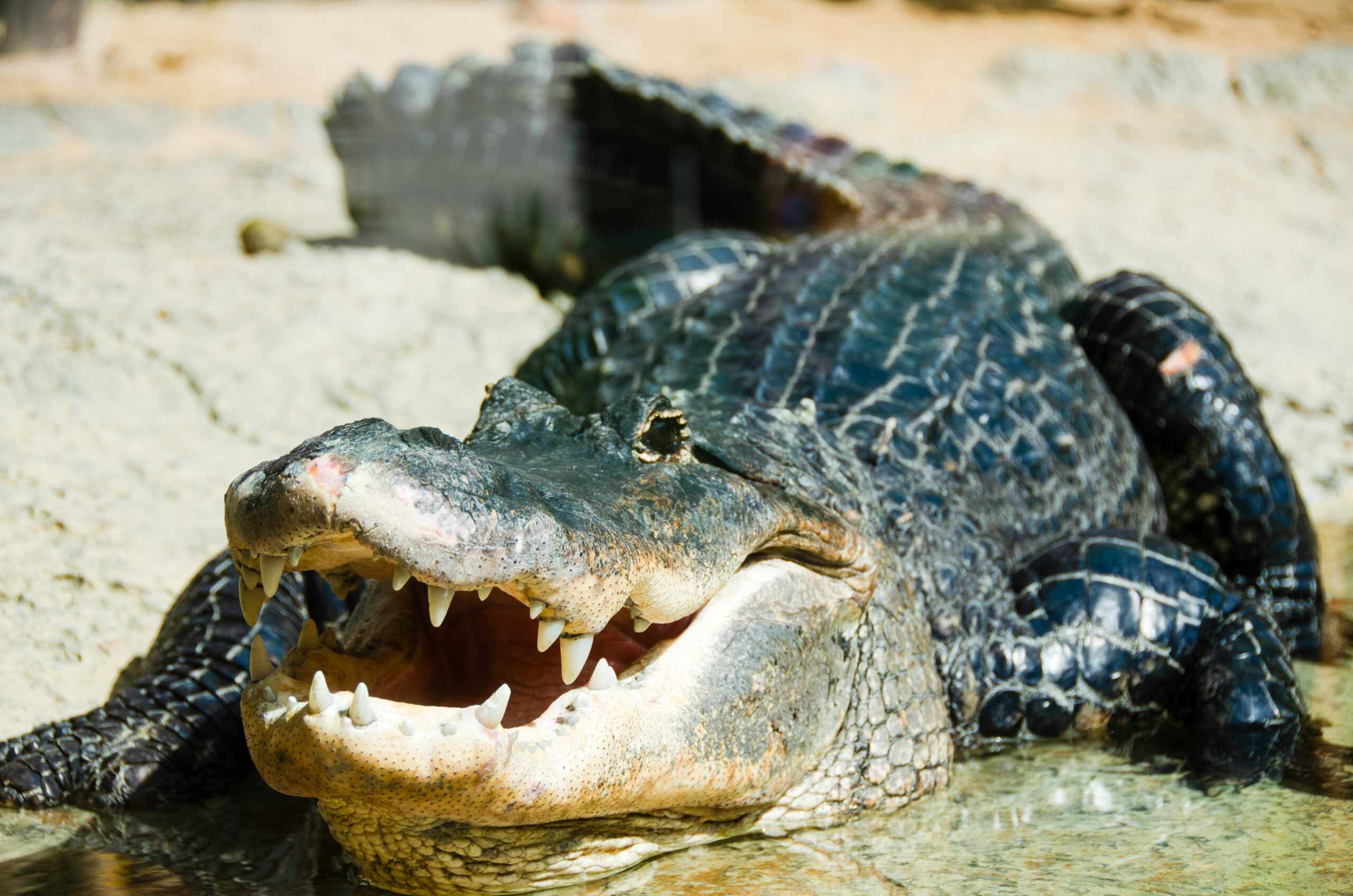

The American alligator is predominantly nocturnal and spends most of its time in the water, although it also travels across land in search of new habitats or prey.
Regarding territorial behaviour, females tend to remain within smaller home ranges, while males may occupy much larger territories, which they defend—primarily from other males. Only during the breeding season do both sexes expand their territories.
Young alligators stay in the area where they hatch, benefiting from the protection of their mother. They do not leave their birthplace until they are around 2–3 years old.
Moreover, this species has a notable capacity for vocal and visual communication, using bellows as well as a variety of body postures and head-slaps.

Female alligators reach sexual maturity between 10 and 16 years of age, although this may vary depending on factors such as climate.
In terms of breeding behaviour, the mating season takes place between April and May, after an elaborate courtship. Subsequently, nest building and egg laying occur during June and July.
The nest, constructed by the female, is a mound made from local vegetation. Depending on her size, age and the conditions of the habitat, she lays between 30 and 50 eggs, which she then incubates for 63–84 days.

Alligators mainly inhabit freshwater environments such as swamps, lakes, marshes and streams. They may also be found in brackish or salt water—despite their limited tolerance—but only for feeding purposes.
Their distribution covers the south-eastern United States, including the states of North Carolina, South Carolina, Arkansas, Louisiana, Florida, Georgia, Texas, Oklahoma, Alabama and Mississippi.

Conservation status
To distinguish an alligator from a crocodile, we can focus on two key features:


Teeth in constant renewal
Throughout their lives, their teeth wear down; however, worn teeth are replaced, allowing an alligator to produce up to 3,000 teeth over its lifetime.
A long lifespan
In the wild, they can live for up to 50 years, while individuals under human care have been known to reach 70 years.
Cold resistance
They are one of the few crocodilian species capable of tolerating cold temperatures; instead of hibernating, they can enter a prolonged state of torpor.
Juvenile tail stripes
Juveniles display bright yellow stripes on their tails, which darken as they grow.

As part of our educational and awareness work on biodiversity, we have developed an encyclopaedia about cetaceans. This comprehensive document offers scientific data and insights into their behaviour, as well as the myths and facts surrounding these fascinating animals.
Certificado de bienestar animal de la Asociación Británica de Agentes de Viajes (ABTA)
Certificado Europeo por la Responsabilidad Ambiental desde 2005

Certificado Humane Conservation con la máxima calificación al mejor parque zoológico de Europa American Humane Association (AHA) EEUU
Certificados desde 2008 por el Instituto de Turismo Responsable y desde 2021 cumpliendo con las acciones Biosphere LifeStyle alineadas con los 17 Objetivos de Desarrollo Sostenible de la Agenda 2030 de las Naciones Unidas

ISO 9001 – Certificado TUV Rheinland Sistema de gestión de calidad certificado respecto a la norma ISO 9001 desde 2013 ISO 14001 y Certificado TUV Rheinland por el alto respeto al Medio Ambiente desde 2005