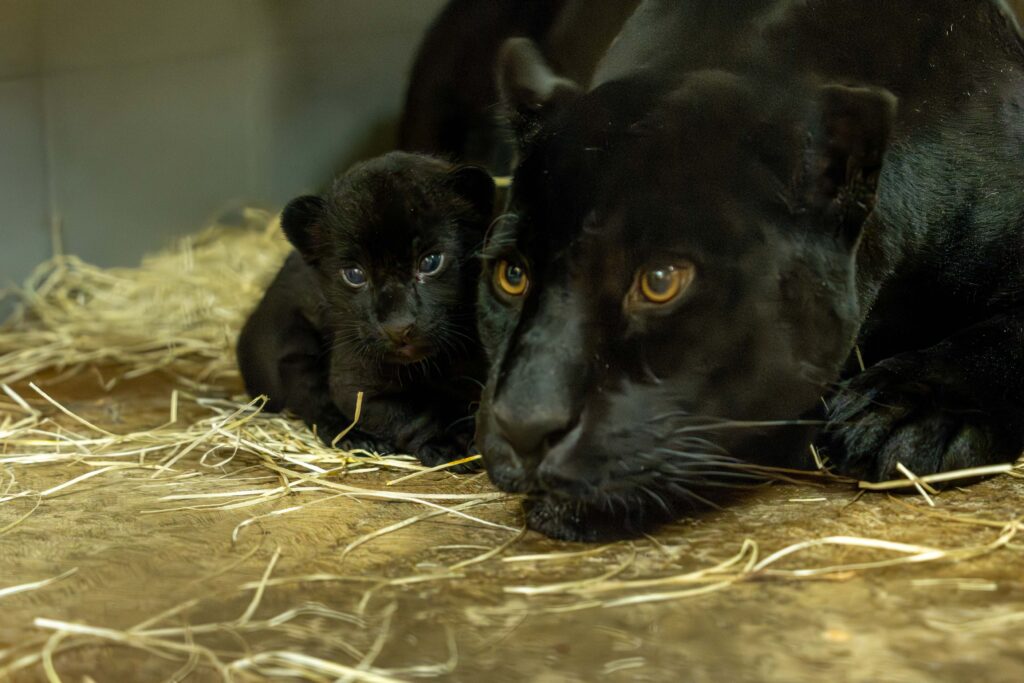
The new cub, the result of the exceptional compatibility between Tito and Naya, reinforces the European Endangered Species Programme (EEP)
The park is bringing the male, female and cub together for the first time, opening a new chapter in jaguar management and conservation
Loro Parque is once again at the forefront of international conservation with the birth of a new jaguar cub (Panthera onca), the result of the union between Tito and Naya, a pair that has shown exceptional affinity from the outset.
The birth is part of the European Endangered Species Programme (EEP), coordinated by the European Association of Zoos and Aquaria (EAZA), whose aim is to ensure genetically healthy populations in human care and to strengthen the future of endangered species.
Tito was born in December 2013 in Saint Petersburg and arrived at Loro Parque in October 2025 from Hodonín Zoo (Czech Republic) as part of the EEP programme, which is part of the European strategy to strengthen the reproduction of this species, whose population in the wild is rapidly declining. Naya, meanwhile, was born in January 2017 at Martinique Zoo and joined Loro Parque in March 2019.
The jaguar population has declined by 25% in just the last 20 years across most of its range and it is particularly delicate in several regions: in Argentina, populations are very fragmented; in El Salvador and Uruguay, it has already disappeared.
Since their arrival, Tito and Naya have shown extraordinary compatibility, with behaviours that the team had never observed before in the female.
“From day one, we knew we were dealing with an extraordinary genetic and behavioural combination. Tito is a very important jaguar genetically, and Naya, in addition to being an exemplary mother, also has a very high genetic value. This birth is a very significant achievement for the European jaguar population,” explains Daniel Rodríguez, head of terrestrial mammals at Loro Parque.
The pair gave birth to two cubs. Unfortunately, one of them was very small and weak and died shortly after birth, not unusual amongst wild jaguars and other cats, whilst the other is very strong and active.
For the first time in the park’s history, it has been decided to keep the male throughout the gestation, birth and rearing process, an innovative approach that has required exhaustive monitoring.
During the pregnancy, weight checks were carried out almost daily and hormone analyses (progesterone and oestrogen) were performed using urine samples to anticipate the moment of birth. As the birth approached, Naya was separated, but with visual access to Tito, so he has been able to watch events and keep in contact with the mother and cub. Thanks to cameras installed inside the enclosure, the team was able to monitor both births and observe the calm behaviour of the male, who remained attentive whilst watching Naya.
A week after the birth, the cameras captured a particularly significant moment: Naya voluntarily brought the baby to the viewing area to show it to Tito. After watching their behaviour closely on Monday 23 February 2026, for the first time at Loro Parque, the male was allowed back in with the female and his cub. The initial signs are very positive, although the team remains constantly and prudently vigilant.
“This step demonstrates the maturity and skill our team here at Loro Parque. By carefully monitoring the animals natural behaviours we have been able to reunite Tito and Naya as soon as possible, prioritising their welfare, but also contributing knowledge to the scientific community and the European conservation network,” says Mike Jordan, director of Loro Parque.
“Ensuring the future of the jaguar requires commitment, science and international cooperation. This birth is not only good news for Loro Parque, but also for the European and global conservation of the species. Each new life represents real hope for an animal whose future in the wild is increasingly uncertain,” says Wolfgang Kiessling, president of the Loro Parque Group.
With this new cub, Loro Parque consolidates its role as an international benchmark in ex situ conservation and reinforces its commitment to protecting global biodiversity, demonstrating that coordinated work, scientific rigour and a passion for nature are the basis for ensuring a future for endangered species.