Green or military macaw
Ara militaris
Ara militaris
The military macaw (Ara militaris), also known as the green macaw, is a characteristic species of tropical forests and mountain forests in Central and South America. Medium-sized, it can reach around 71 cm in length. Its green plumage provides effective camouflage in its environment.
Unlike other macaws more commonly associated with humid tropical lowland forests, such as the scarlet macaw (Ara macao), this species stands out for being found in deciduous and semi-deciduous tropical forests, including mountainous areas, inhabiting a wider altitudinal range.


WEIGHT
Between 972 and 1,134 g

DIET
Herbivorous

ORIGIN
Central and South America

INCUBATION
26 days
WEIGHT
Between 972 and 1,134 g
DIET
Herbivorous
ORIGIN
Central and South America
INCUBATION
26 days
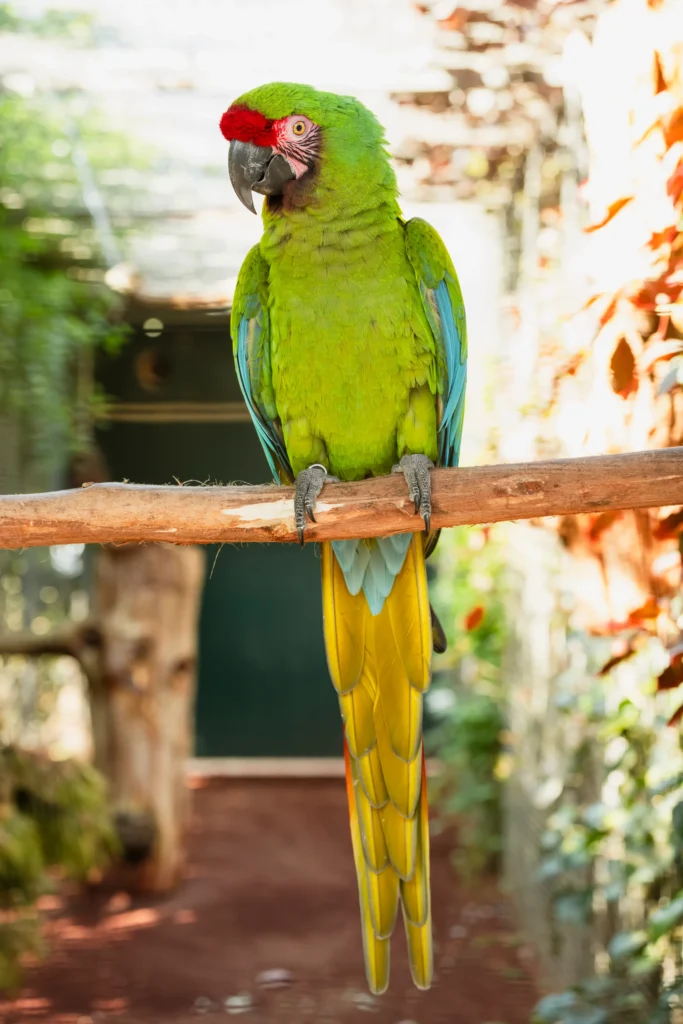
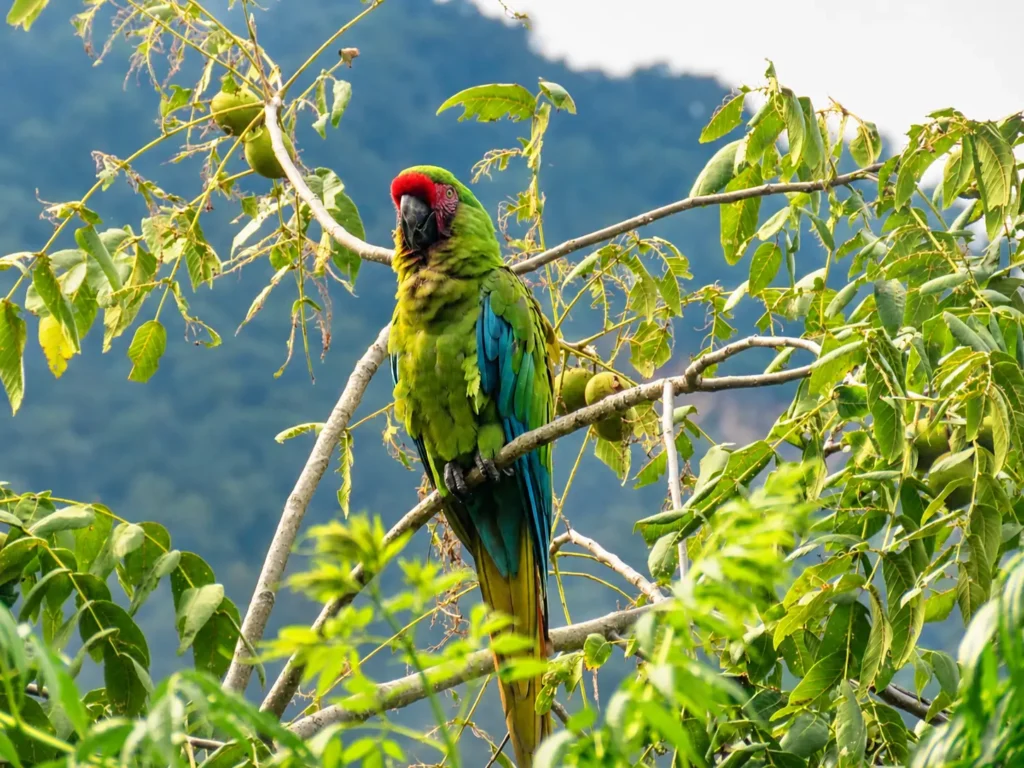
Ara militaris, occasionally confused with the great green macaw (Ara ambiguus), stands out for its predominantly green plumage, which contrasts with its red forehead. The flight feathers are blue on the upper side and olive-yellow on the underside.
The tail is mostly blue, red at the base and yellow underneath. It belongs to the genus Ara, like other large macaws, such as the scarlet macaw and the blue-and-yellow macaw.
On its face, it has a bare white area that extends to the eye, which may show reddish tones. Fine lines formed by small black feathers can be seen over this facial patch.
Its beak is strong and curved, adapted for breaking open seeds and hard fruits. Like other psittacines, it has zygodactyl feet, which allow it to manipulate food with great precision.
Immature individuals are similar to adults. There are three subspecies: Ara militaris mexicanus, which is slightly larger than the other two; Ara militaris bolivianus, which has a brown patch on the throat; and Ara militaris militaris.
Its diet consists mainly of seeds, but it also regularly consumes fruits, leaves, flowers, figs, palm nuts, and has even been observed consuming latex from certain stems.
Its diet varies according to the seasonal availability of resources, allowing it to adapt to different environments throughout its geographical range, unlike more specialised species such as the hyacinth macaw, which depends heavily on palm fruits.


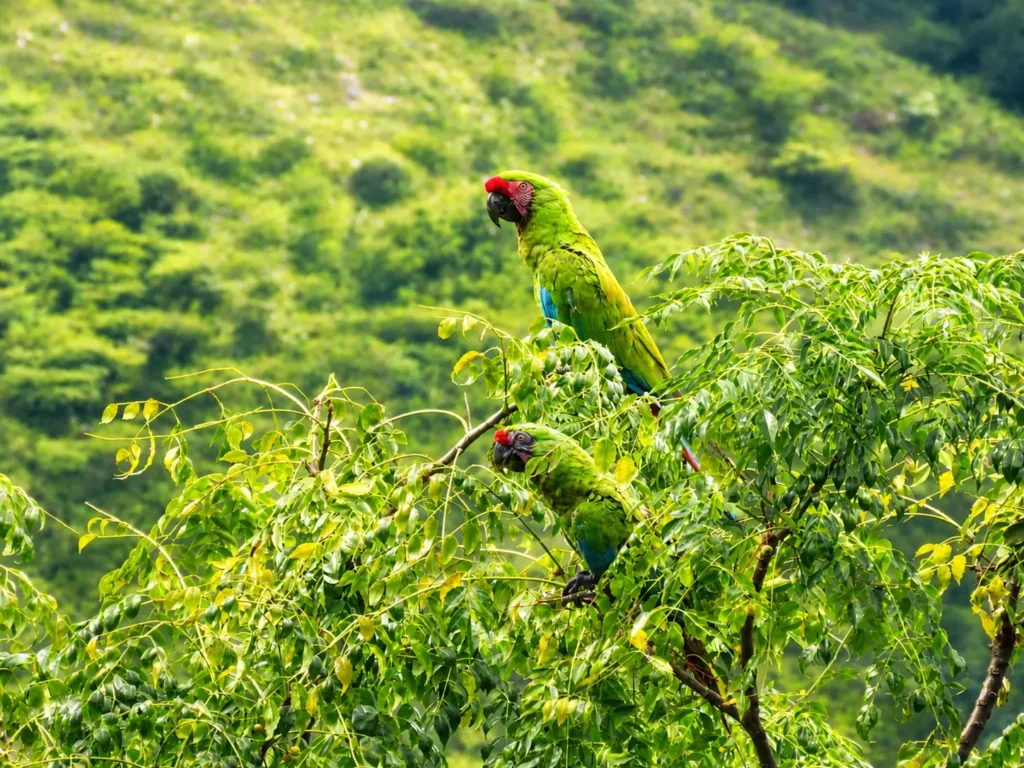
Like other macaws, it is a diurnal and social species, moving around in pairs or small groups. Depending on the region, it may nest and roost both on cliffs and in tree cavities.
Depending on the area it inhabits, it has been observed making long-distance movements associated with the seasonality of certain fruits and climatic conditions. Its call is similar to that of other members of the genus Ara: loud and strident, although slightly finer in sound, and audible from some distance.

They form monogamous pairs that can remain together for long periods. They nest in tree cavities or cliff holes, depending on the environment. The availability of suitable nesting sites, especially cliffs or mature trees, is key to the species’ reproductive success. In addition, under human care, breeding is regular, which helps reduce pressure on wild populations.
The female generally lays between 2 and 3 eggs, with an incubation period of approximately 26 days. During this time, the male is responsible for feeding the female while she incubates the eggs, and later both parents care for the chicks. The chicks remain in the nest for around 12 to 13 weeks until their feathers are fully developed.
This species is distributed from Mexico to northern Argentina. However, its distribution is very irregular, as it is absent from much of Central America.
It can be found between 600 and 2,600 m in a variety of evergreen montane forests, gallery forests, pine and oak formations, as well as dry forests. It may occasionally be seen in humid forests, thorn forests and lowland habitats. Its presence is closely linked to the availability of roosting and nesting sites.
Adapted to mountain areas
Use of cliffs for nesting
Great ability to travel
Dentro de nuestra labor informativa y formativa sobre biodiversidad hemos desarrollado una enciclopedia sobre los cetáceos. Es un documento extenso donde encontrarás datos e información científica sobre el comportamiento y los mitos y verdades que rodean a estos animales.

Certificado de bienestar animal de la Asociación Británica de Agentes de Viajes (ABTA)

Certificado Europeo por la Responsabilidad Ambiental desde 2005

Certificado Humane Conservation con la máxima calificación al mejor parque zoológico de Europa American Humane Association (AHA) EEUU

Certificados desde 2008 por el Instituto de Turismo Responsable y desde 2021 cumpliendo con las acciones Biosphere LifeStyle alineadas con los 17 Objetivos de Desarrollo Sostenible de la Agenda 2030 de las Naciones Unidas

ISO 9001 – Certificado TUV Rheinland Sistema de gestión de calidad certificado respecto a la norma ISO 9001 desde 2013 ISO 14001 y Certificado TUV Rheinland por el alto respeto al Medio Ambiente desde 2005