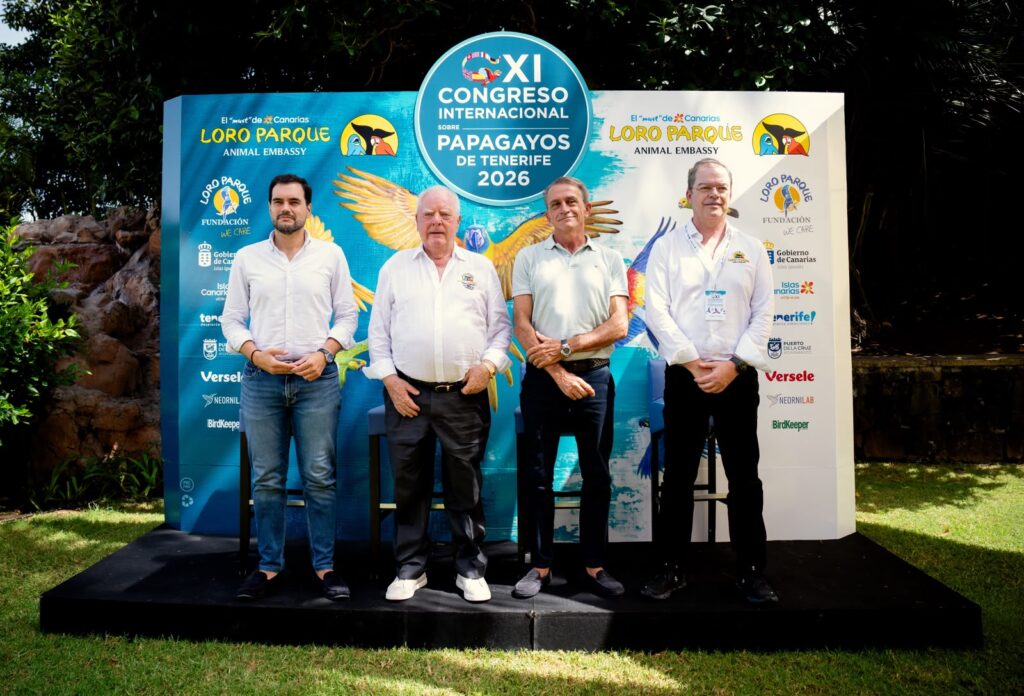
The 11th International Parrot Convention of Tenerife brings together a record number of 800 experts from 57 countries, with 15 new nations participating compared to previous editions
Loro Parque and the Loro Parque Foundation have officially launched the 11th International Parrot Convention of Tenerife, a historic event marking four decades of science and conservation since its first edition in 1986. From today until 17 September, Puerto de la Cruz becomes the global hub of psittacology, bringing together a record number of 800 biologists, vets, scientists, breeders and conservationists from more than 55 countries, surpassing all previous editions and including representatives from 15 nations attending the event for the first time.
The event enjoys the institutional backing of the Government of the Canary Islands, through Promotur Turismo de Islas Canarias; the Tenerife Island Council, via Tenerife Tourism Corporation; and Puerto de la Cruz Town Council, in a joint effort that positions the island as an international benchmark in wildlife research and conservation.
During the presentation, the president of Loro Parque and founder of the Congress, Wolfgang Kiessling, recalled the origins of a forum closely linked to the history of the park, which was founded in 1972: “When we first organised this congress in 1986, I never imagined that we would be here, four decades later, celebrating not only the continuity of an event, but also the growth of a global community united by a shared passion for parrots.”
Kiessling also highlighted the purpose behind the event’s inception: “to bring together people from all corners of the world to share knowledge, experiences and dreams centred on these exceptional birds. Today, this gathering is an international benchmark in the conservation, welfare and breeding of parrots.”
Loro Parque’s Vice-President, Christoph Kiessling, highlighted the scale the event has reached: “The fact that 800 specialists from nearly 60 countries are gathering in Tenerife demonstrates the scale that a Congress born here four decades ago has now attained. Our aim is for all this exchange of knowledge to help generate real solutions for the conservation of species and their habitats.”
The scientific director of the Loro Parque Foundation, Rafael Zamora, summarised the transformation in our understanding of psittacines over these four decades: “Forty years ago, much of the information came from accumulated experience. Today we are discussing genetics, nutrition, veterinary medicine, biosecurity, behaviour and environmental enrichment. Science allows us to understand these species ever better and to develop more effective tools to protect them.”
The highly specialised scientific programme includes presentations by leading international experts, technical ‘Leaders Breakfast’ sessions and exclusive visits to the Loro Parque Fundación Breeding Centre, a facility that safeguards the world’s largest living genetic reserve of parrots.
Speaking on behalf of the Government of the Canary Islands, the Director-General for Infrastructure, Sustainability and Tourism Quality, Héctor Mateo, highlighted the strategic value of the event for the archipelago: “Events of this scale showcase the Canary Islands as a region committed to a higher-value model of tourism, capable of attracting expertise, fostering international cooperation and moving forward hand in hand with sustainability.”
On behalf of Turismo de Tenerife, its Chief Executive, Dimple Melwani, linked the event’s success to the island’s legacy: “In 1972, Wolfgang Kiessling launched a project that has become a global benchmark for its commitment to research, animal welfare and environmental education. Hosting this Congress is fully in line with Tenerife’s tourism strategy, in which sustainability is not merely an objective, but the guiding principle behind our decisions.”
The mayor of Puerto de la Cruz, Leopoldo Afonso, emphasised this with a message of local pride: “We are proud that an event born in Puerto de la Cruz has become an international benchmark. Over the course of these days, we are welcoming hundreds of specialists and reinforcing our position as a destination capable of bringing together tourism, knowledge, science and conservation.”
With this eleventh edition, Puerto de la Cruz once again becomes, for four days, the leading international meeting point for parrot science and conservation, strengthening the global cooperation needed to protect these species and the ecosystems on which their future depends.