Groups of meerkats have been observed sharing burrows with other species, such as yellow mongooses (Cynictis penicillata), Cape ground squirrels (Xerus inauris), and rock hyraxes (Procavia capensis), among others.
Meerkats
Suricata suricatta
Suricata suricatta
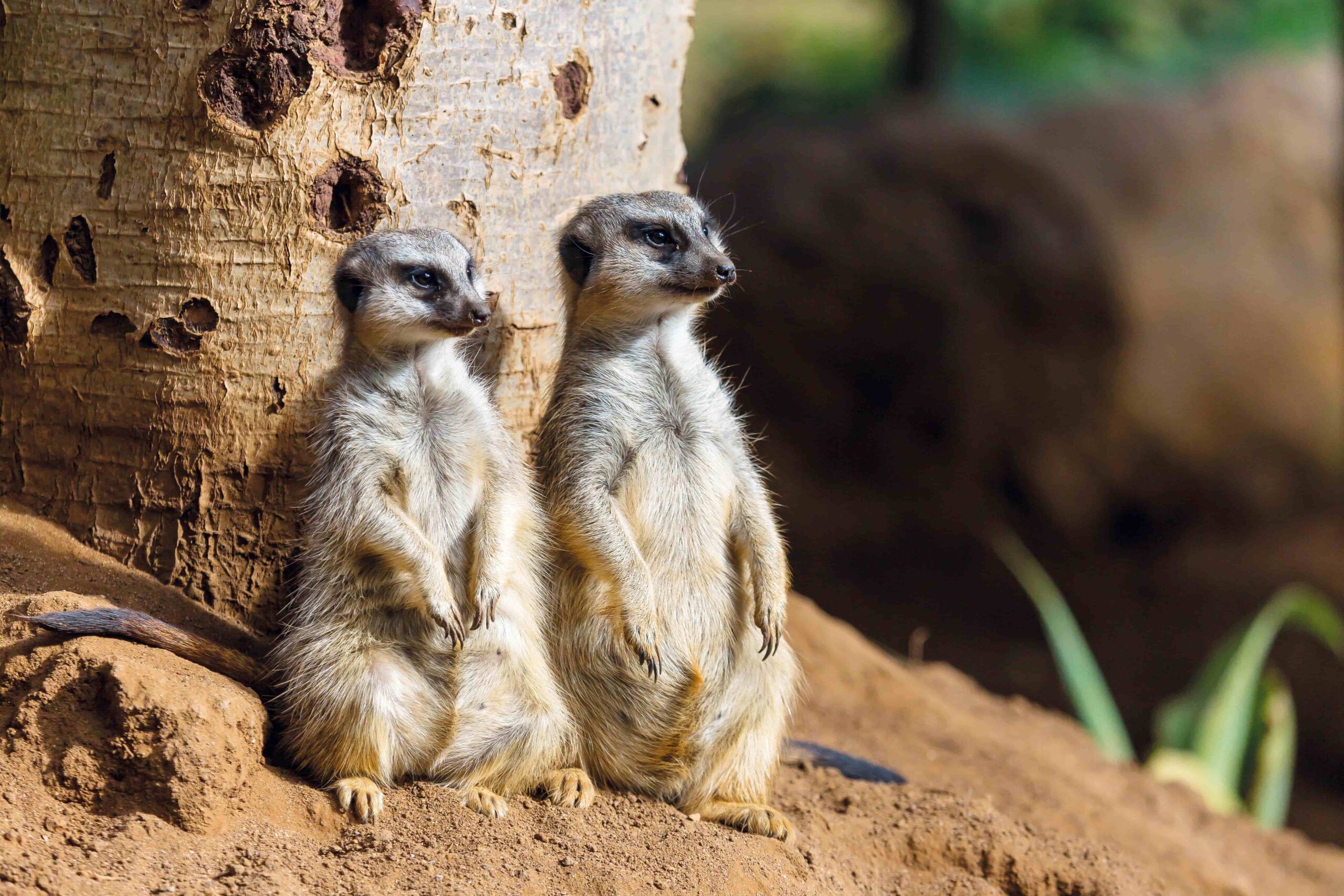
Meerkats, native to southern Africa, are small mammals renowned for their social behaviour and characteristic upright stance when keeping watch. They live in organised colonies, working together for survival, and feed on insects and small vertebrates. Their remarkable digging skills and keen awareness of predators set them apart. However, habitat loss poses a growing threat to their survival, highlighting the need to protect them in order to preserve the balance of their ecosystems.

WEIGHT
0.6 – 0.9 kg

DIET
Primarily carnivorous (insectivorous)

ORIGIN
Africa

GESTATION
8 – 10 weeks
The meerkat, also known as the suricate, is a small carnivorous mammal belonging to the herpestidae family, whose members are commonly referred to as mongooses. It typically weighs between 600 and 900 grams. Its body and limbs are long and slender, with a head–body length of around 25–35 cm. The tail is thin and relatively long, measuring between 17.5 and 25 cm.
Its coat is generally mottled grey, cinnamon, or brown, while the nose may be pink, black, brown, or a mixture of several colours. Compared with other mongoose species, its fur is short; the forelimbs are equipped with four strong, curved claws adapted for digging, and the cinnamon-coloured tail ends in a black tip.
Meerkats have a dark ring surrounding their large eyes, thought to help reduce glare from the sun—an ideal adaptation for life in the arid ecosystems of southern Africa.
Meerkats are carnivorous animals with a predominantly insect-based diet, although they may also include certain vertebrates such as geckos and snakes. Their food consists largely of invertebrates including scorpions (thanks to their tolerance to certain toxins), beetles, butterflies, moths, spiders, crickets, centipedes, millipedes, and worms. They rarely drink water, as they obtain moisture from the prey they consume, but during the driest periods they may chew fruit or other plant parts to stay hydrated.
When foraging, meerkats actively dig in the soil, among grasses, and beneath rocks to find what they need.


Meerkats are highly social and live in cooperative family groups known as clans or colonies, which can comprise up to 50 individuals. These groups operate with a clear hierarchy and divided roles: while some forage, others act as sentinels, keeping watch from elevated positions and giving specific alarm calls when predators are spotted.
They are diurnal animals and spend the night in complex underground burrow systems with multiple entrances, which provide protection and serve as the centre of their daily activities.

Meerkat reproduction is tied to the rainy season, as increased rainfall brings greater food availability. Each group has a dominant breeding pair. The dominant female is usually the one that reproduces, although subordinate females may occasionally rear young. Gestation lasts around 8–10 weeks, after which 3 to 7 pups are born, entirely dependent at first as they arrive with eyes and ears closed.
The pups remain in the burrow for their first few weeks and are cared for collectively by the group, a clear example of cooperative breeding. Meerkats reach sexual maturity between 12 and 24 months, although females typically will not breed until at least three years of age.

Meerkats are found in southern Africa, primarily in western and southern Namibia, south-western Botswana, and northern and western South Africa, with a small presence in the far south-west of Angola.
They inhabit open arid or semi-arid areas such as savannahs and plains, characterised by short grasses and little woody vegetation (trees and shrubs). Although they may use burrows made by other animals, they prefer firm soils for constructing their own dens.

Conservation status
Hierarchy and reproductive control in meerkats
Each meerkat family has a dominant pair; the dominant female will not allow subordinate females to breed, and if they do, she may kill their offspring.
Daily foraging and changing group routes
Meerkats spend around 5–8 hours a day foraging. “Mobs” (the English term for large groups composed of several meerkat families) follow different routes each day to avoid depleting food sources.
Coexistence with other species in shared burrows
As part of our educational and awareness work on biodiversity, we have developed an encyclopaedia about cetaceans. This comprehensive document offers scientific data and insights into their behaviour, as well as the myths and facts surrounding these fascinating animals.

Certificado de bienestar animal de la Asociación Británica de Agentes de Viajes (ABTA)

Certificado Europeo por la Responsabilidad Ambiental desde 2005

Certificado Humane Conservation con la máxima calificación al mejor parque zoológico de Europa American Humane Association (AHA) EEUU

Certificados desde 2008 por el Instituto de Turismo Responsable y desde 2021 cumpliendo con las acciones Biosphere LifeStyle alineadas con los 17 Objetivos de Desarrollo Sostenible de la Agenda 2030 de las Naciones Unidas

ISO 9001 – Certificado TUV Rheinland Sistema de gestión de calidad certificado respecto a la norma ISO 9001 desde 2013 ISO 14001 y Certificado TUV Rheinland por el alto respeto al Medio Ambiente desde 2005