An international study published in The Journal of the Acoustical Society of America demonstrates, for the first time, how bottlenose dolphins identify different materials using echolocation whilst swimming – a key breakthrough for science and ocean conservation.
An international team of scientists has provided new insights into how bottlenose dolphins (Tursiops truncatus) combine echolocation and movement to distinguish objects made of different materials whilst swimming. The research, carried out entirely at Loro Parque’s facilities in Tenerife, is the first scientific study to combine cognition and acoustics using the institution’s animals, and places this centre at the global forefront of research.
The study, carried out by researchers from the University of Southern Denmark and Loro Parque Fundación, demonstrates that dolphins are capable of distinguishing between spheres made of different materials – such as plastic, aluminium, brass or steel – using only their biosonar, even when the objects are visually identical. Through a sophisticated system of emitting ultrasonic ‘clicks’ and analysing the echoes these generate as they bounce back, the dolphins construct a mental representation of their surroundings in real time, in a similar way to how a high-precision ultrasound scanner reconstructs an image from sound.
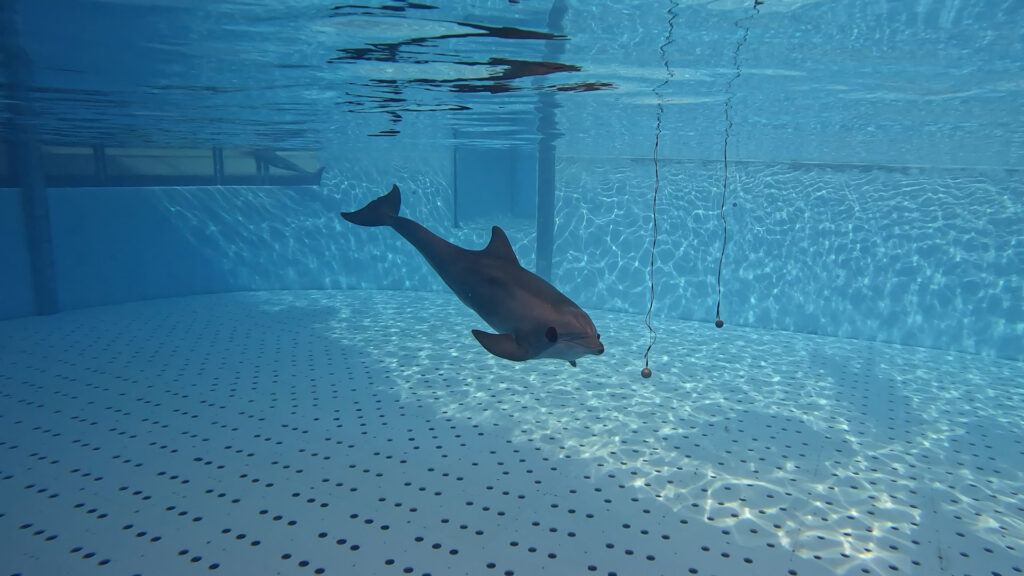
To achieve this, the scientific team trained Achille and Clara, two bottlenose dolphins resident at Loro Parque, to swim towards a pair of spheres suspended in the water and select, using sound alone, the one made of the correct material. Using highly sensitive hydrophones and synchronised underwater cameras, the researchers recorded how the animals turned their heads, altered their swimming trajectory and adjusted their echolocation clicks in the fractions of a second leading up to their final decision.
This research would not have been possible without the unique environment provided by Loro Parque. Achille and Clara participated on a completely voluntary basis in each of the working sessions, a fact that reflects the high standard of animal welfare and the bond of trust built between the dolphins and their team of carers over years of positive reinforcement training. The quality of veterinary care, the experience of the training team and Loro Parque’s specialised facilities are factors that are very difficult to replicate in other contexts, which has enabled the collection of scientific data of exceptional rigour and precision.
The president of the Loro Parque Group, Wolfgang Kiessling, emphasised that “this study reaffirms our unwavering commitment to science and the protection of biodiversity. At Loro Parque, we not only care for our animals to the highest welfare standards, but we also open our doors to the international scientific community to generate knowledge that is vital for saving the oceans”.
“Without the close collaboration between our team of experts and the researchers, discoveries of this magnitude simply could not be made,” added Kiessling.
The study also compares, for the first time and under the same experimental protocol, the performance of bottlenose dolphins with that of harbour porpoises, another species of cetacean capable of echolocation. The results show that both species employ very similar active exploration strategies, turning their heads and varying their swimming trajectory to scan their target, but that their acoustic signals—which differ in frequency and structure—endow them with different discrimination capabilities. This finding provides valuable insights into how evolution has shaped each species’ sonar according to its biological needs and the acoustic environment in which it lives.
Understanding, at this level of detail, how cetaceans perceive and interpret their acoustic environment has direct implications for conservation, as it allows us to better anticipate how human-generated underwater noise may interfere with these animals’ ability to locate food, navigate or communicate, and helps to design more precise and effective protective measures for their wild populations.
Sara Torres, the lead scientist on the project, noted that ” andve discovered that dolphins actively adjust their movements and sound production to ‘see’ the composition of objects as they swim”, and highlighted that “it is fascinating to see how Achille and Clara use their clicks to obtain detailed information about their surroundings. This basic knowledge is essential for understanding how changes and noise in the aquatic environment affect cetaceans and enables us to develop conservation measures that are far more effective and tailored to the biology of each species”.
The article has been published in *The Journal of the Acoustical Society of America* (JASA), one of the world’s leading journals in acoustics, and was produced in collaboration with the University of Southern Denmark (SDU) and Loro Parque Fundación. The research, funded by the Office of Naval Research, the Human Frontiers Science Programme and the Carlsberg Foundation, pushes the boundaries of knowledge on animal cognition and provides essential scientific tools for the management and protection of cetacean populations.