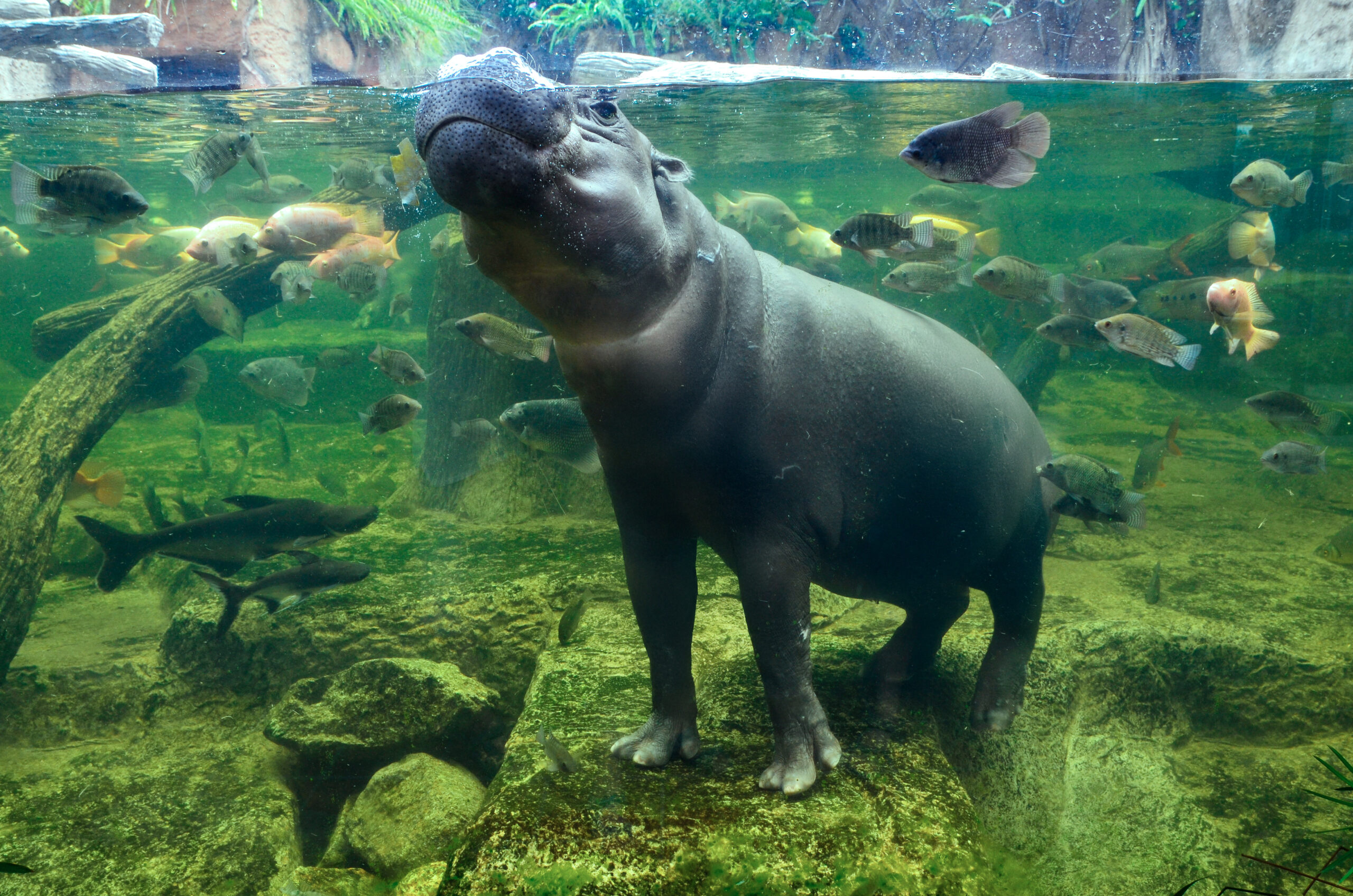
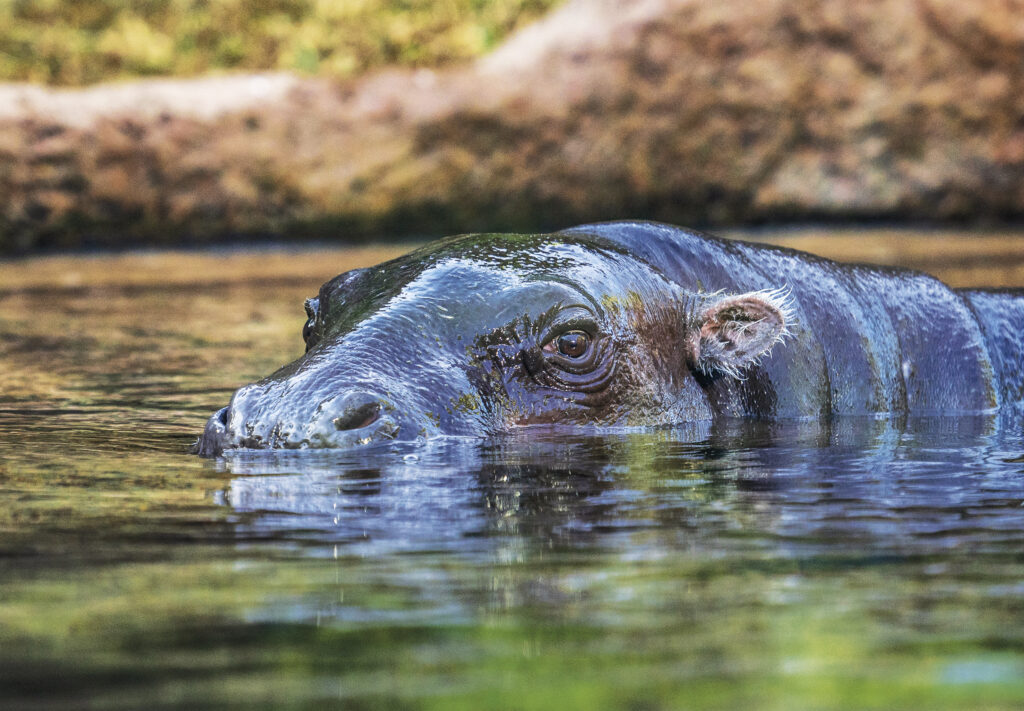
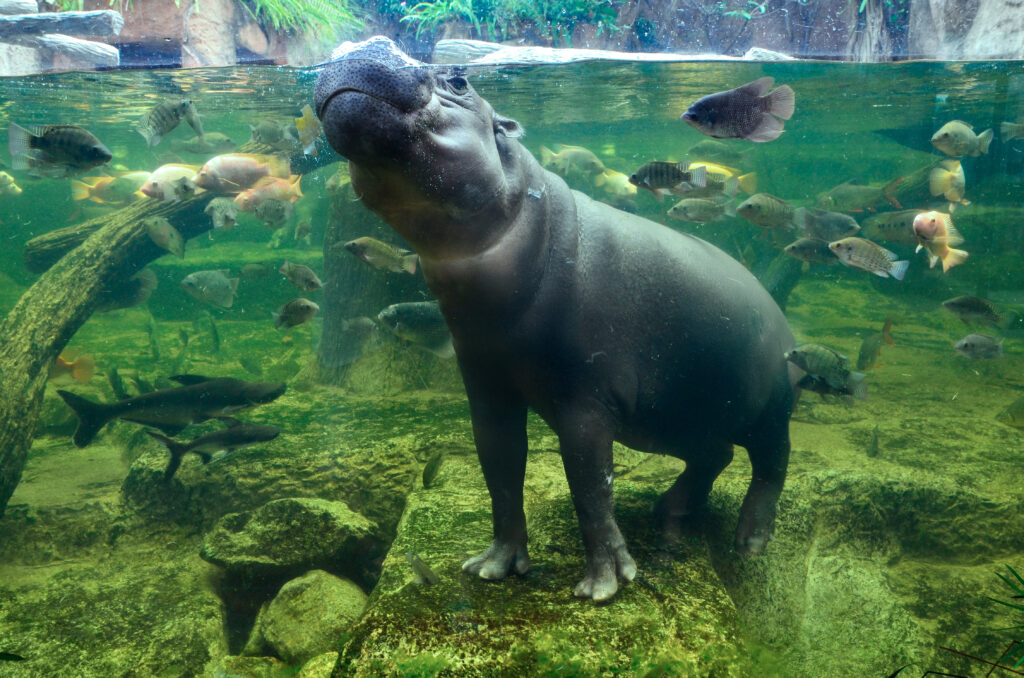
They are excellent swimmers and can close their nostrils and ears when diving
Pygmy hippopotamus
Choeropsis liberiensis
Choeropsis liberiensis
The pygmy hippopotamus is a semi-aquatic mammal that is considerably smaller than its close relative, the common hippopotamus. It inhabits the dense forests and swamps of West Africa, mainly in Liberia, Sierra Leone, Guinea and Côte d’Ivoire. Although it tends to be nocturnal, this is not exclusive, and it generally leads a solitary life except when females are rearing young or during the breeding season.

WEIGHT
180 – 275 kg

DIET
Herbivorous

ORIGIN
West Africa

GESTATION
184 – 210 días
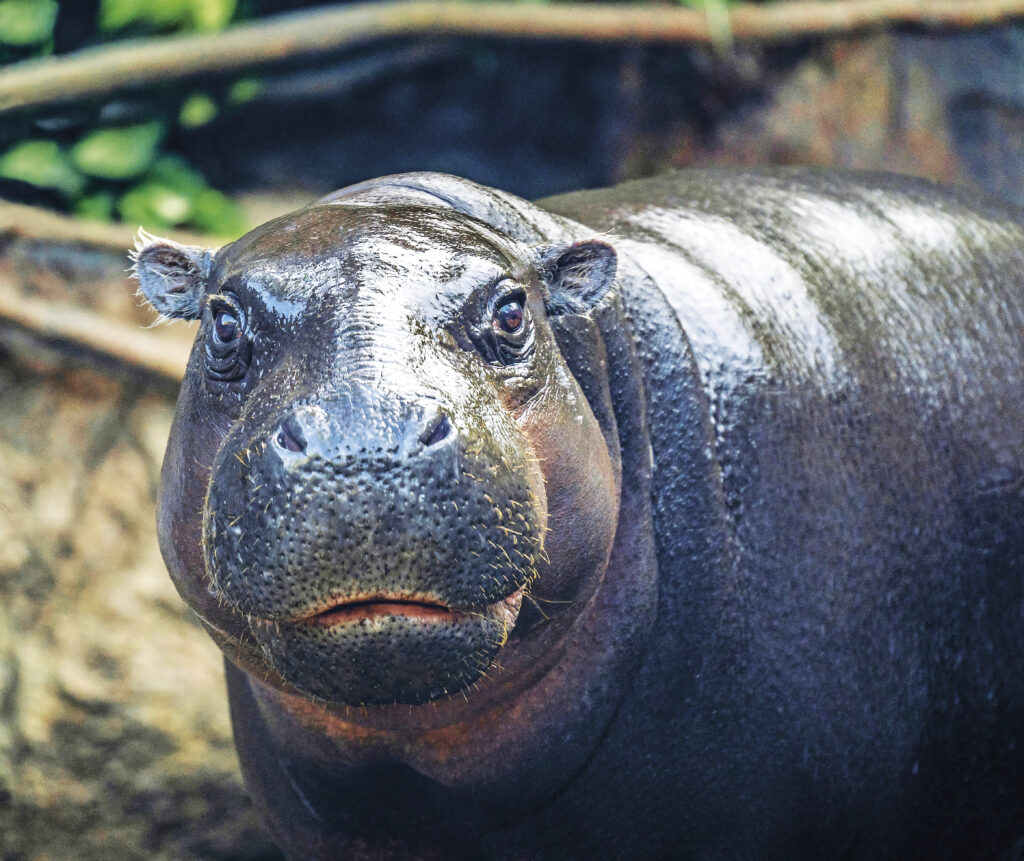
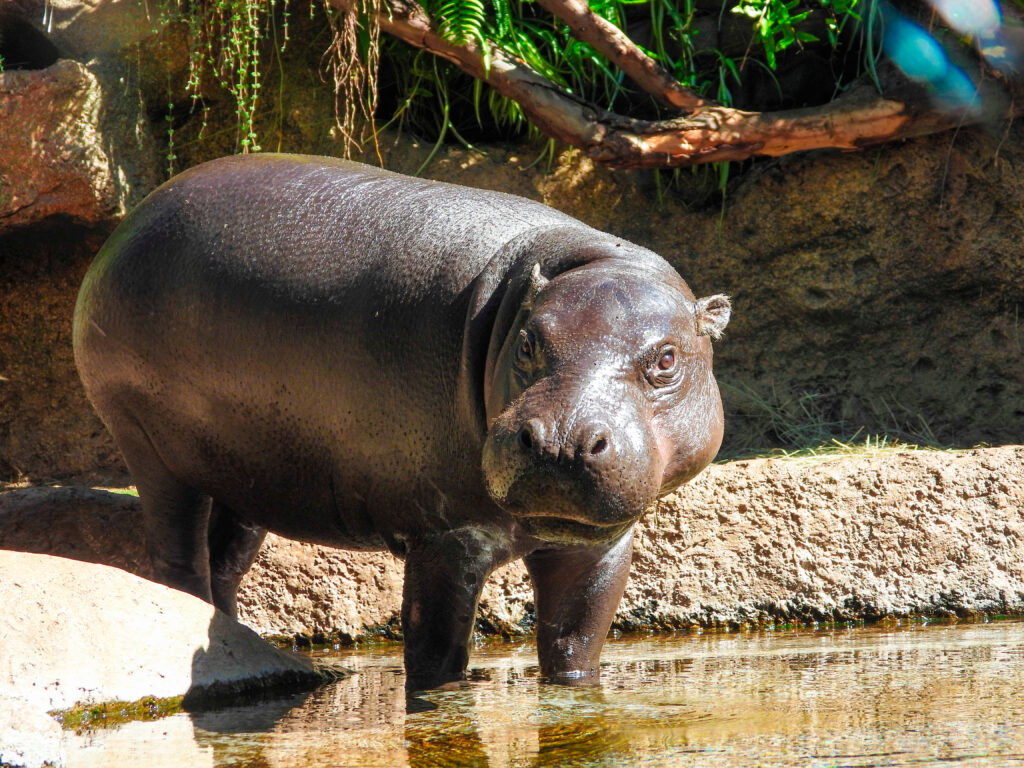
Males and females of this species are similar in size, measuring between 1.50 and 1.77 metres in length, with a height that does not exceed 83 centimetres and a weight ranging from 180 to 275 kg. Their skin is dark brown or greyish, becoming lighter on the underside.
Moreover, unlike the common hippopotamus, the eyes and nostrils of the pygmy hippo do not protrude as prominently—an adaptation that reflects its more terrestrial lifestyle.
The pygmy hippopotamus is herbivorous. It feeds on a wide variety of plant species, which vary according to geographical location and season. Its diet includes branches, shoots, grasses, ferns and fruits, as well as tubers and roots from several plant species.
It is believed that they may consume more than 150 different plant species. They generally spend around 5–6 hours a day feeding, mostly during the late afternoon and throughout the night.


The pygmy hippopotamus is predominantly solitary and essentially nocturnal. During the day, it usually remains hidden and resting in humid areas, emerging at dusk to feed. Despite its compact and heavy body, it moves with surprising agility both on land and in water, using well-trodden paths through dense vegetation.
Although individuals mark their territory with faeces, they tend to be tolerant of others, often ignoring each other where territories overlap.

Sexual maturity is reached between 4 and 5 years of age. The oestrous cycle of the female lasts around 35 days, with a heat period of 24–48 hours. The average gestation period is 188 days, after which a single calf weighing 4.5–6.2 kg is born; twins are extremely rare.
Moreover, weaning occurs between the sixth and eighth month. During the first 3–5 months, the calf does not accompany the mother while she forages, instead remaining hidden in pools or other secluded spots.

The pygmy hippopotamus inhabits dense tropical forests and wetlands in West Africa, with current populations in Liberia, Sierra Leone, Guinea and Côte d’Ivoire. It is also considered extinct in countries such as Nigeria.
Unlike the common hippopotamus, which lives in riverine savannahs, the pygmy hippopotamus prefers forested areas with access to water sources.
Conservation status
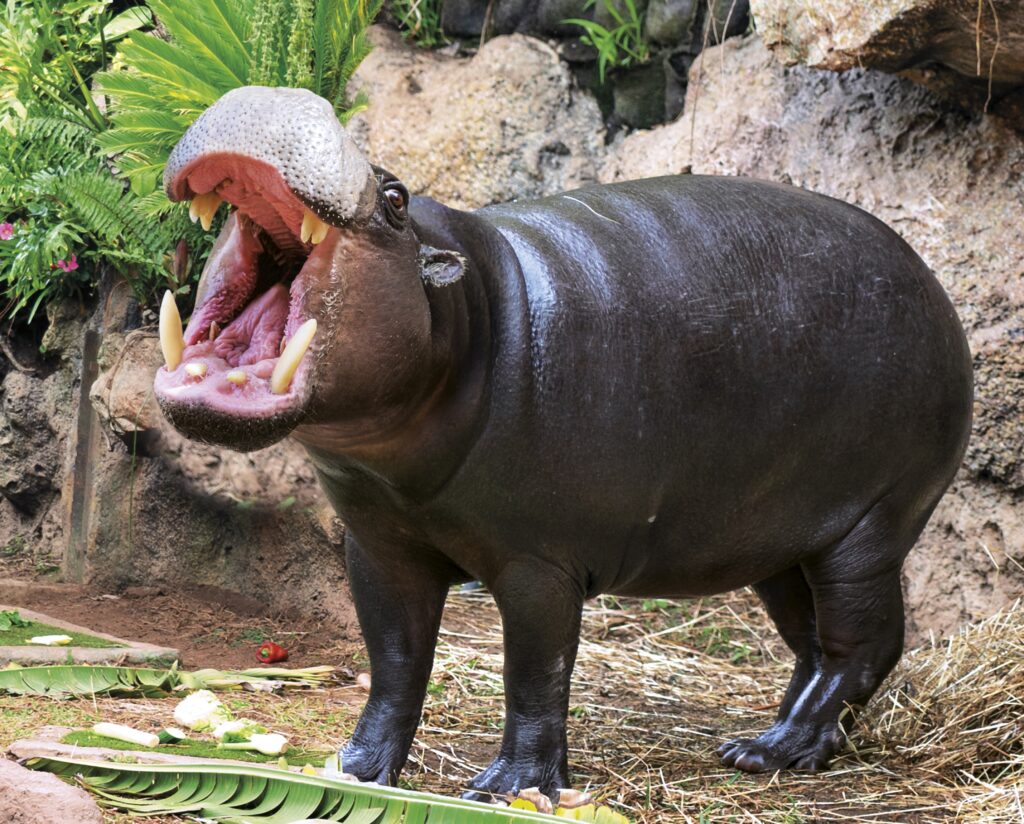
Terrestrial habits
Skilled swimmers
Very specific predators
Excluding human hunting, adult individuals of this species are only preyed upon by the leopard and the Nile crocodile
Protective physiology
They have glands that produce a reddish-brown secretion, which is often mistaken for blood sweat, but is in fact neither sweat nor blood. These secretions help protect their skin from sunlight
Difficult to observe

As part of our educational and awareness work on biodiversity, we have developed an encyclopaedia about cetaceans. This comprehensive document offers scientific data and insights into their behaviour, as well as the myths and facts surrounding these fascinating animals.

Certificado de bienestar animal de la Asociación Británica de Agentes de Viajes (ABTA)
Certificado Europeo por la Responsabilidad Ambiental desde 2005

Certificado Humane Conservation con la máxima calificación al mejor parque zoológico de Europa American Humane Association (AHA) EEUU
Certificados desde 2008 por el Instituto de Turismo Responsable y desde 2021 cumpliendo con las acciones Biosphere LifeStyle alineadas con los 17 Objetivos de Desarrollo Sostenible de la Agenda 2030 de las Naciones Unidas

ISO 9001 – Certificado TUV Rheinland Sistema de gestión de calidad certificado respecto a la norma ISO 9001 desde 2013 ISO 14001 y Certificado TUV Rheinland por el alto respeto al Medio Ambiente desde 2005