Guaruba or Golden Parakeet
Guaruba guarouba
Guaruba or Golden Parakeet
Guaruba guarouba
Guaruba guarouba
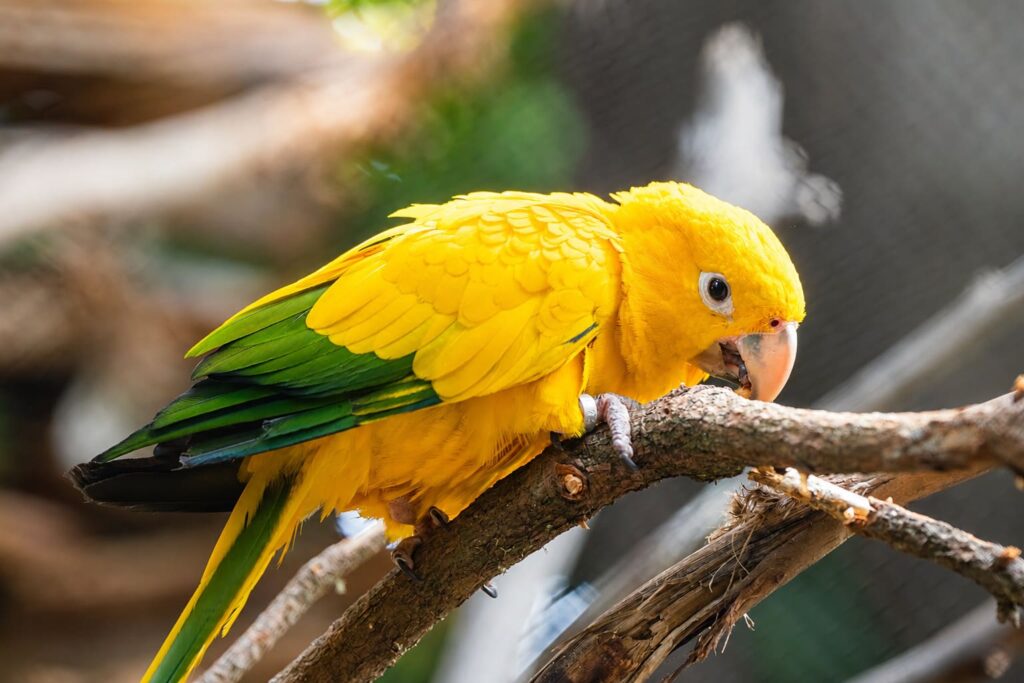
The guaruba, also known as golden conure and golden parakeet, is one of the most striking birds of the Amazon, thanks to the intense yellow colour of its plumage. Endemic to Brazil, this species lives in the Amazon basin, where it moves mainly through the canopy of tropical rainforests — the upper layer formed by the crowns of the trees.
Although it was long grouped with conures because of its size, its social behaviour and feeding habits actually place it closer to macaws. For this reason, in some educational contexts, it is also referred to as the guaruba macaw.


WEIGHT
194 – 225 g

DIET
Herbivorous

ORIGIN
Brazil (endemic)

INCUBATION
30 days
PESO
Entre 194 y 225 g
ALIMENTACIÓN
Herbívora
ORIGEN
Brasil (endémica)
INCUBACIÓN
30 días
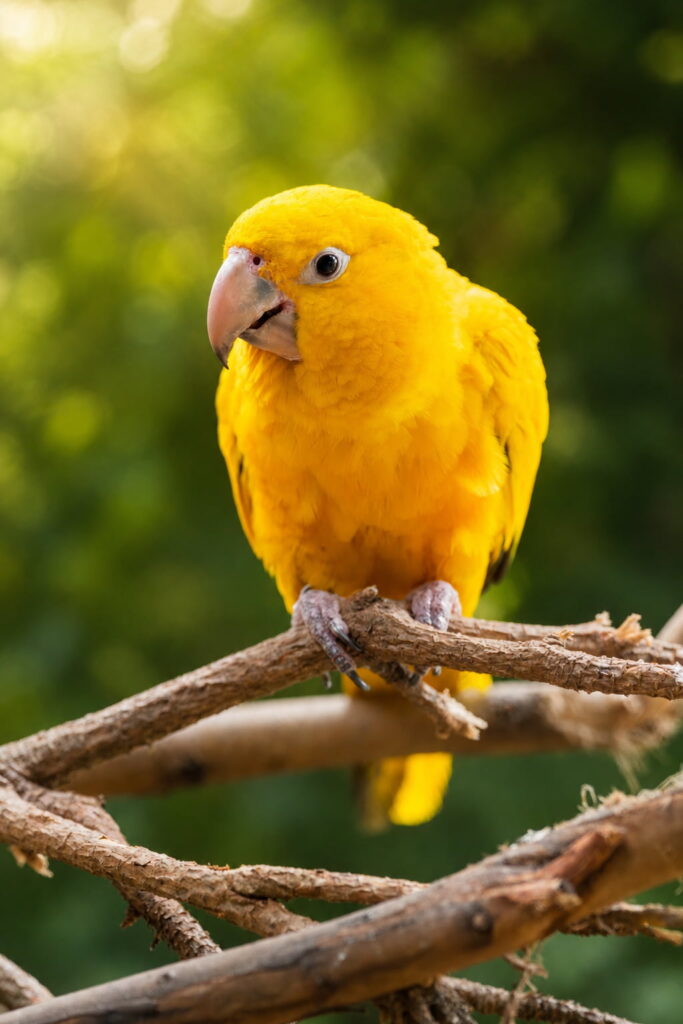
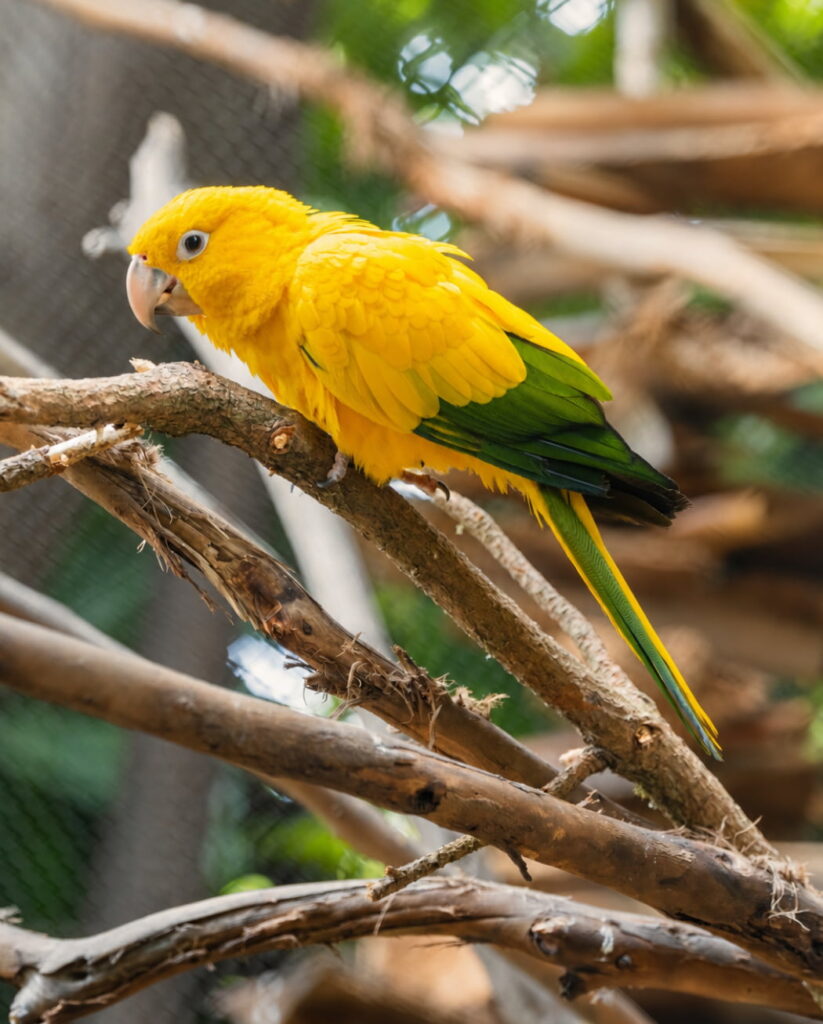
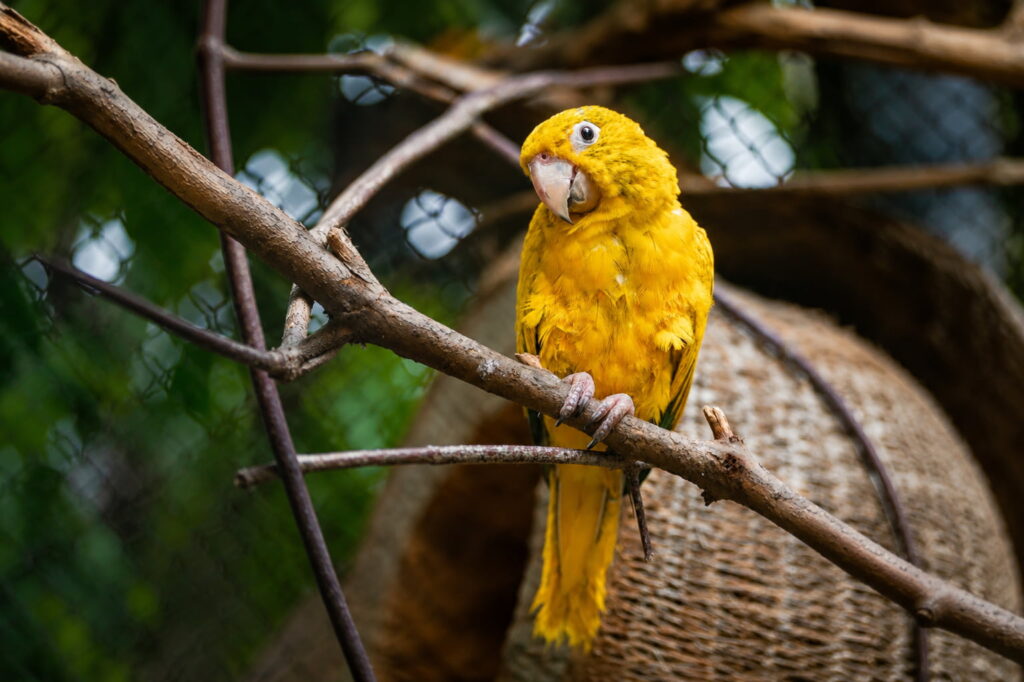
Guaruba guarouba is a medium-sized psittacine that reaches around 34 cm in length and weighs between 194 g and 255 g. Its plumage is almost entirely yellow, except for some green feathers on the wings, which contrast with the rest of the body.
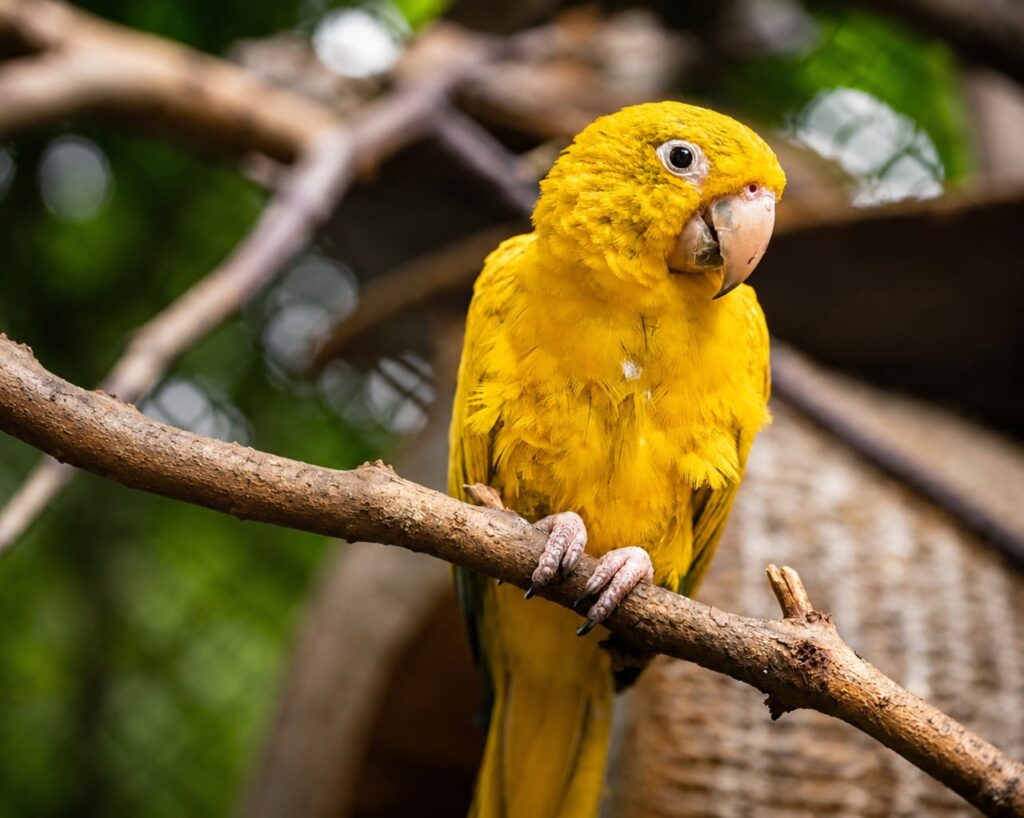
This parakeey has a white orbital ring and pink legs. Besides, younger Guaruba guarouba individuals have a less robust beak and may also show pale green tones on the head and wing coverts.
Its diet is varied and flexible, as it is not specialised in one particular type of food. It consumes fruit, seeds, pulp, buds, nectar, flowers and bark, adapting to the availability of resources throughout the year. Its diet changes according to the season and the area in which it is found.
This variety allows the species to make use of many different resources in its environment. At times, this also includes nearby crops, such as maize or fruit trees. Despite its flexibility, in certain areas it has been seen to show an affinity for some fruits, such as açaí and murici, as well as for specific plant species.


The guaruba is a clearly gregarious species. These highly social birds usually form flocks of between 4 and 20 individuals, although groups of almost 50 have been observed in feeding areas. In resting areas, they spend a great deal of time playing and social preening, with frequent interactions between individuals.
They move mainly through the forest canopy and may spend the whole day in feeding areas. In addition, they have been observed using similar routes over several days between resting and feeding sites, foraging on the same trees until the food is exhausted. While most of the flock feeds, one or two individuals remain alert and take on a lookout role.

One of the most distinctive aspects of the guaruba is its reproductive behaviour. Unlike many other psittacine species, such as the blue-and-yellow macaw (Ara ararauna) or the military macaw (Ara militaris), it remains in large flocks during the breeding season. This behaviour has been linked to the possibility that breeding pairs may have “breeding helpers”.
As this is a highly social species, observations in nesting areas show that preening between a pair often involves other individuals. Even so, during this season, pairs have been seen leaving the flock and separating to copulate.
The incubation period has been estimated at 30 days in birds kept in human care, while adult body mass is reached at around 60 days. In the wild, they nest in cavities in tall trees in open areas close to forest, showing a preference for dead trees, as these are easier to occupy and hollow out.
Successful breeding in human care is uncommon and is generally limited to specialised centres, as the species requires very specific conditions for reproduction to take place.

The guaruba is endemic to Brazil and is native to the Brazilian Amazon. Its distribution area does not exceed 300,000 km², occurring along the edge of the Brazilian Shield, east of the Madeira River and south of the Amazon River.
This species appears to prefer primary forest below 300 metres in altitude within the Amazon basin. However, it can also be found feeding in secondary forests and flooded forests, an ecosystem known as igapó.
For nesting and resting, guarubas often use trees in disturbed areas close to forested zones. This may help reduce the risk of predation by monkeys or snakes. The species avoids the humid areas of central Amazonia, as well as the colder regions of the south.

Predation by other birds
Shared care
Queen of Bavaria

As part of our educational and awareness work on biodiversity, we have developed an encyclopaedia about cetaceans. This comprehensive document offers scientific data and insights into their behaviour, as well as the myths and facts surrounding these fascinating animals.

Certificado de bienestar animal de la Asociación Británica de Agentes de Viajes (ABTA)

Certificado Europeo por la Responsabilidad Ambiental desde 2005

Certificado Humane Conservation con la máxima calificación al mejor parque zoológico de Europa American Humane Association (AHA) EEUU

Certificados desde 2008 por el Instituto de Turismo Responsable y desde 2021 cumpliendo con las acciones Biosphere LifeStyle alineadas con los 17 Objetivos de Desarrollo Sostenible de la Agenda 2030 de las Naciones Unidas

ISO 9001 – Certificado TUV Rheinland Sistema de gestión de calidad certificado respecto a la norma ISO 9001 desde 2013 ISO 14001 y Certificado TUV Rheinland por el alto respeto al Medio Ambiente desde 2005