
Noble macaw
Diopsittaca nobilis
Noble macaw
Diopsittaca nobilis
Diopsittaca nobilis
The noble macaw, also known as the red-shouldered macaw or dwarf macaw, is one of the smallest macaw species and among the most agile. Unlike larger macaws, it has a more discreet and adaptable nature, allowing it to thrive across a wide range of habitats.


WEIGHT
129 – 169 g

DIET
Herbivorous

ORIGIN
South America

INCUBATION
24 – 26 days
WEIGHT
129 – 169 g
DIET
Herbivorous
ORIGIN
South America
INCUBATION
24 – 26 days
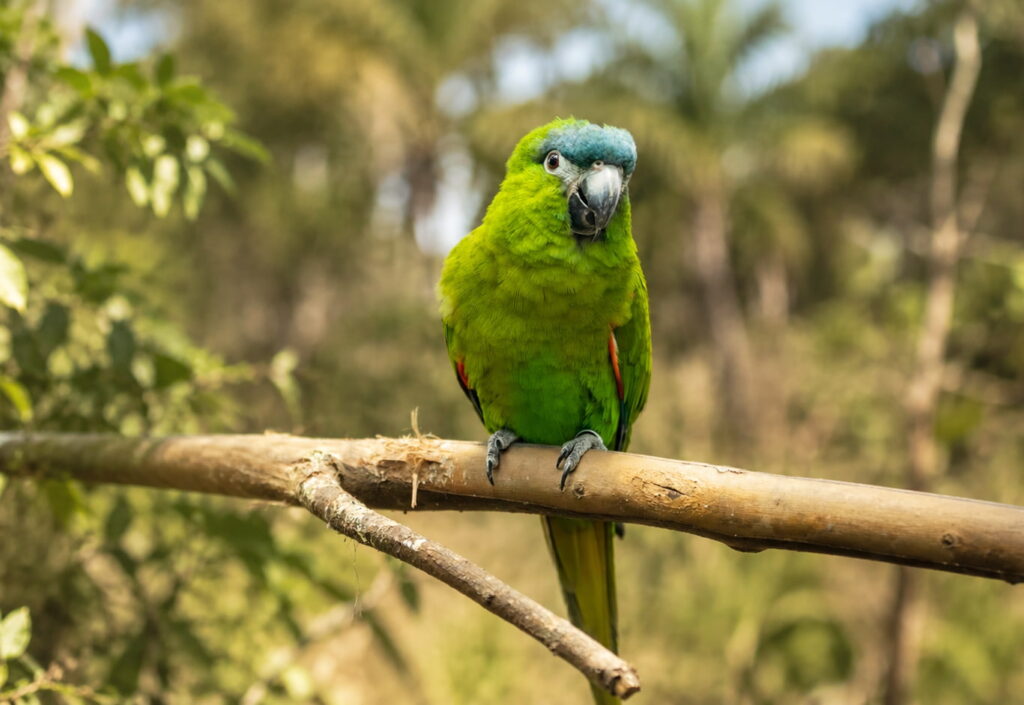
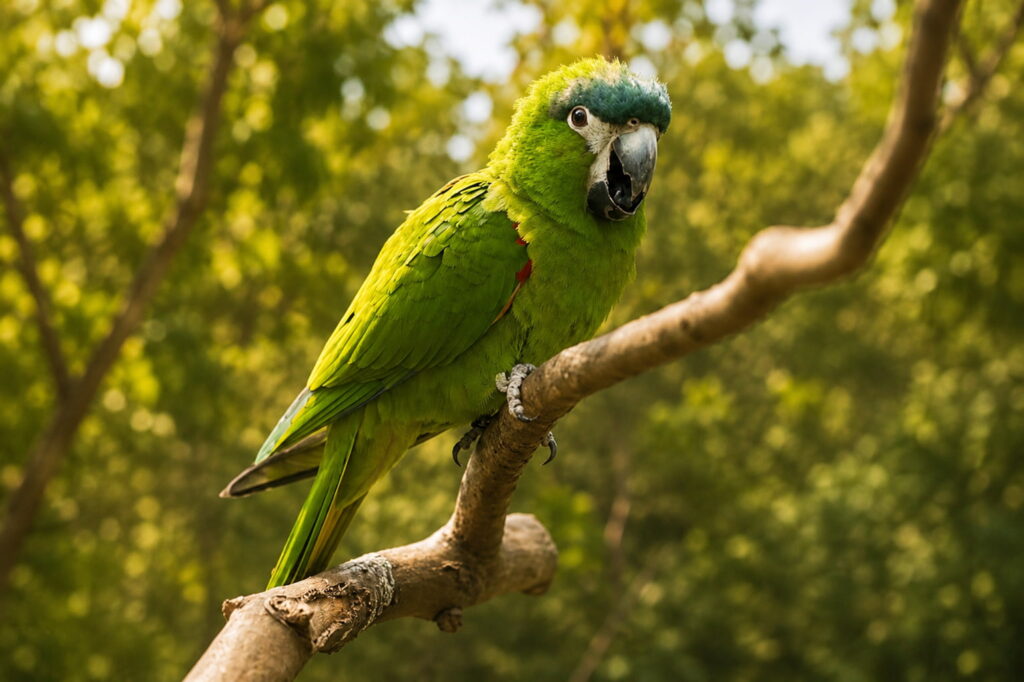
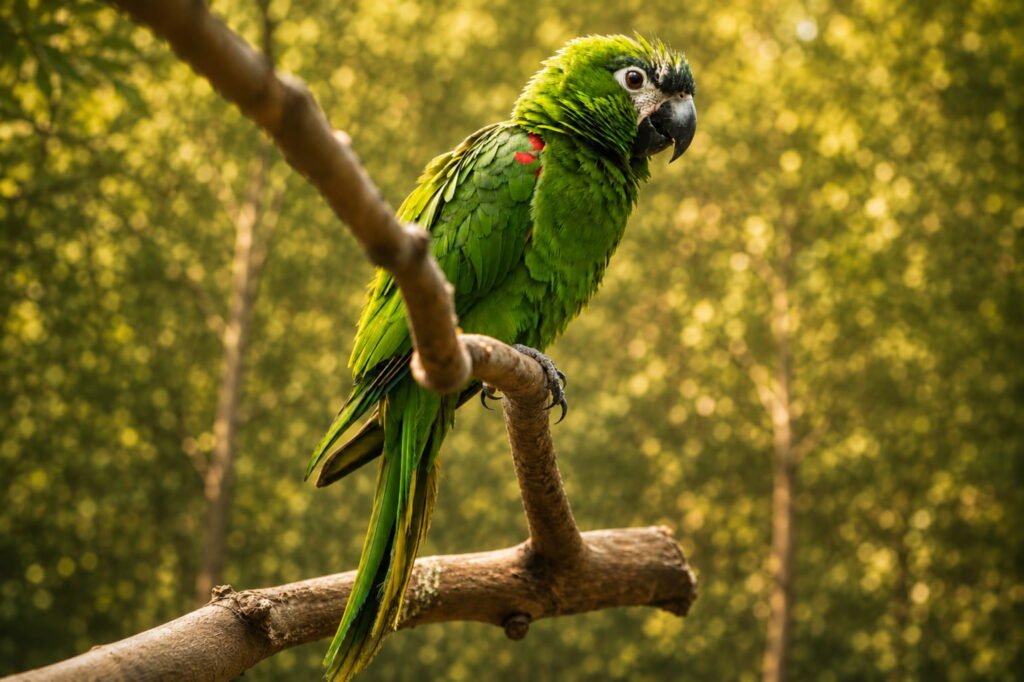
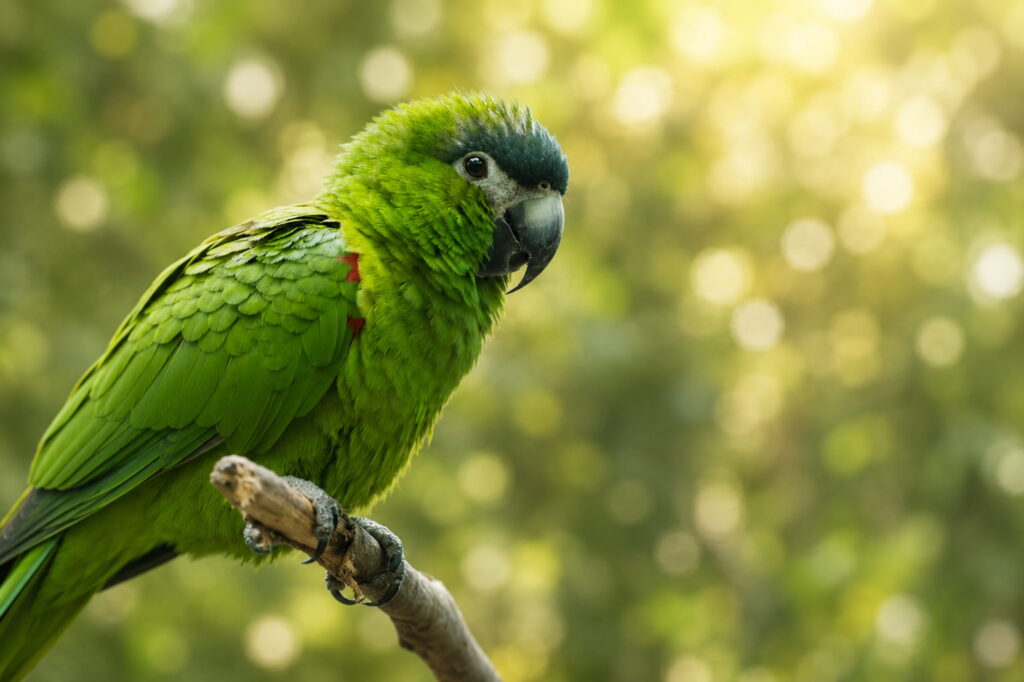
Diopsittaca nobilis is especially notable for its small size. Its plumage is predominantly green, with bluish tones on the forehead and small red patches on the inner wing, along the wing edge and close to the base.
Its beak is relatively small and blackish in colour, a feature that helps distinguish it from Diopsittaca cumanensis, whose beak is much darker.
It also has a white facial patch extending from the beak to the eye. As with other parrots, its zygodactyl feet allow it to handle food with remarkable precision.
The noble macaw feeds mainly on seeds, fruits and flowers, although its flexible diet allows it to make use of whatever resources are available in different environments. This adaptability is one of the reasons it can occupy such a broad range of habitats.
At times, flocks have also been seen feeding in cultivated fields and rice paddies.


This is a diurnal, active and highly agile species, usually seen moving in pairs or small groups. Outside the breeding season, however, it may gather in much larger flocks. In Suriname, it is thought to behave as an itinerant species, with occasional sightings in urban areas between September and October.
In addition, it is also a very vocal bird in flight. Some of its calls resemble those of conures, while others can be mistaken for the calls of larger macaws.

The species forms monogamous pairs that may remain together for long periods. It nests in tree cavities, especially in palms, as well as in arboreal termite mounds, a particularly characteristic nesting strategy.
The female usually lays between two and four eggs, with incubation lasting 24 to 26 days. Both parents take part in caring for the chicks and, under favourable conditions, may successfully raise broods of up to four young.
The chicks remain in the nest for several weeks until fully feathered, with the nestling period estimated at around 60 days.

The noble macaw is native to north-eastern South America, with a notable presence in Venezuela, Guyana, Suriname, French Guiana and Brazil.
It inhabits savannas, open woodland, palm groves and wetlands, and may also be found in caatinga forests and cultivated areas close to taller forest. The species can occur at elevations of up to 1,400 metres.
Thanks to its adaptability, it is often found in agricultural landscapes and areas modified by human activity, provided there are suitable trees for roosting and nesting. In some regions, this close association with crops means it may be regarded as problematic for agriculture.

Conservation status
The smallest macaw in the world
Higly adaptable
Nesting in termite mounds

As part of our educational and awareness work on biodiversity, we have developed an encyclopaedia about cetaceans. This comprehensive document offers scientific data and insights into their behaviour, as well as the myths and facts surrounding these fascinating animals.

Animal welfare certificate of the Association of British Travel Agents (ABTA).

European Certificate for Environmental Responsibility since 2005

Humane Conservation Certificate with the highest rating for the best zoological park in Europe, American Humane Association (AHA), USA

Certificates since 2008 from the Institute for Responsible Tourism, and since 2021 complying with Biosphere LifeStyle actions aligned with the 17 Sustainable Development Goals of the United Nations’ 2030 Agenda

ISO 9001 – TUV Rheinland Certificate: Certified quality management system according to ISO 9001 standard since 2013. ISO 14001 and TUV Rheinland Certificate for high respect of the Environment since 2005