Red-fronted macaw
Ara rubrogenys
Red-fronted macaw
Ara rubrogenys
The red-fronted macaw, also known as the Cochabamba macaw, is the only macaw species endemic to Bolivia’s inter-Andean valleys. While most macaws are associated with tropical rainforests, this remarkable species has evolved in a very different landscape of rugged mountains, steep cliffs and dry forests, where it finds both food and shelter.
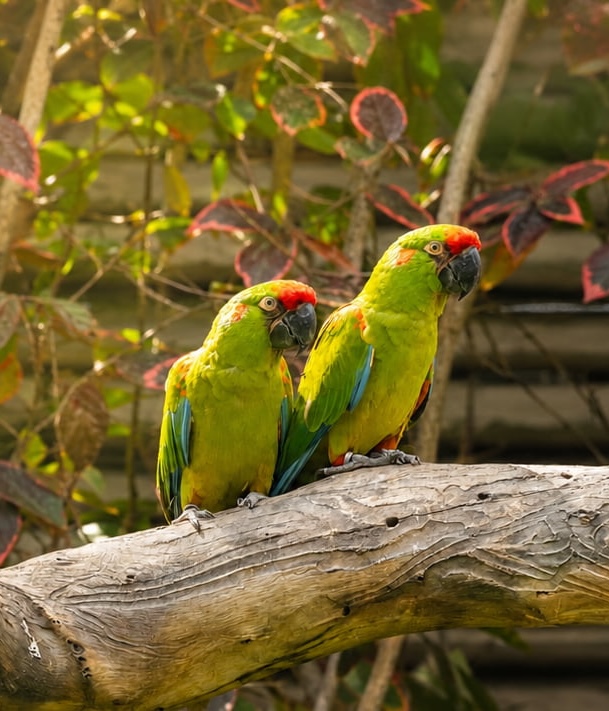
Its vivid orange-red forehead and shoulders stand out against the rich green of its plumage, making it one of Bolivia’s most distinctive and recognisable birds.


WEIGHT
450 – 650 g

DIET
Herbivorous

ORIGIN
Endemic to Bolivia

INCUBATION
26 days
WEIGHT
450 – 650 g
DIET
Herbivorous
ORIGIN
Endemic to Bolivia
INCUBATION
26 days
The red-fronted macaw (Ara rubrogenys) is a medium-sized macaw, measuring between 55 and 60 cm in length and weighing 450–650 g. Although predominantly green, it is instantly recognisable by the striking orange-red colouring on its forehead and shoulders. The flight feathers and parts of the tail are turquoise, while the bright red ear patch is one of the species’ most distinctive features. Immature birds display much paler red markings across the body.
Like other macaws, it has a powerful, curved beak capable of cracking hard seeds, together with zygodactyl feet that allow it to grasp food securely and move with remarkable agility through trees and across rocky cliff faces.
Its diet consists mainly of fruits and flowers from legumes, grasses and cacti. When natural food becomes scarce, it may also forage in nearby croplands, particularly maize and groundnut fields, feeding on kernels left on the ground after harvesting. While this behaviour helps the species survive during periods of food shortage, it can also bring it into conflict with local farmers.


Highly social by nature, red-fronted macaws are usually seen in pairs or small family groups. Outside the breeding season, however, several groups may come together to form larger flocks that travel through the valleys in search of food.
The species also undertakes short seasonal movements, shifting between winter feeding grounds and summer breeding sites. Although it spends much of its time among trees and shrubs, cliffs are an essential part of its daily life, providing safe places to roost and breed.

The red-fronted macaw generally nests in cavities within cliff faces, usually in small colonies. On rare occasions, however, pairs have also been recorded nesting in the endemic palm Parajubaea torallyi.
The incubation period lasts approximately 26 days. Under human care, females typically lay between one and three eggs.
Thanks to carefully managed breeding programmes, an important population now exists to safeguard the future of the species. Today, the red-fronted macaw is successfully bred at Loro Parque Fundación, where it forms part of one of the world’s largest living genetic reserves of parrots. Visitors can also see this remarkable species at Loro Parque Animal Embassy.

The red-fronted macaw is found exclusively in Bolivia, where it inhabits the inter-Andean mesothermal valleys of the Mizque, Caine, Upper Pilcomayo and Grande river basins.
Unlike many macaws that depend on dense tropical forests, this species is adapted to drier environments, including scrubland, dry forest, cactus woodland, valleys and rocky gorges. In addition, this macaw is also regularly seen in agricultural landscapes.
Conservation status
A species found nowhere else on Earth
Cliffs as a natural home
Unmistakable colouring
As part of our educational and awareness work on biodiversity, we have developed an encyclopaedia about cetaceans. This comprehensive document offers scientific data and insights into their behaviour, as well as the myths and facts surrounding these fascinating animals.

Certificado de bienestar animal de la Asociación Británica de Agentes de Viajes (ABTA)

Certificado Europeo por la Responsabilidad Ambiental desde 2005

Certificado Humane Conservation con la máxima calificación al mejor parque zoológico de Europa American Humane Association (AHA) EEUU

Certificados desde 2008 por el Instituto de Turismo Responsable y desde 2021 cumpliendo con las acciones Biosphere LifeStyle alineadas con los 17 Objetivos de Desarrollo Sostenible de la Agenda 2030 de las Naciones Unidas

ISO 9001 – Certificado TUV Rheinland Sistema de gestión de calidad certificado respecto a la norma ISO 9001 desde 2013 ISO 14001 y Certificado TUV Rheinland por el alto respeto al Medio Ambiente desde 2005